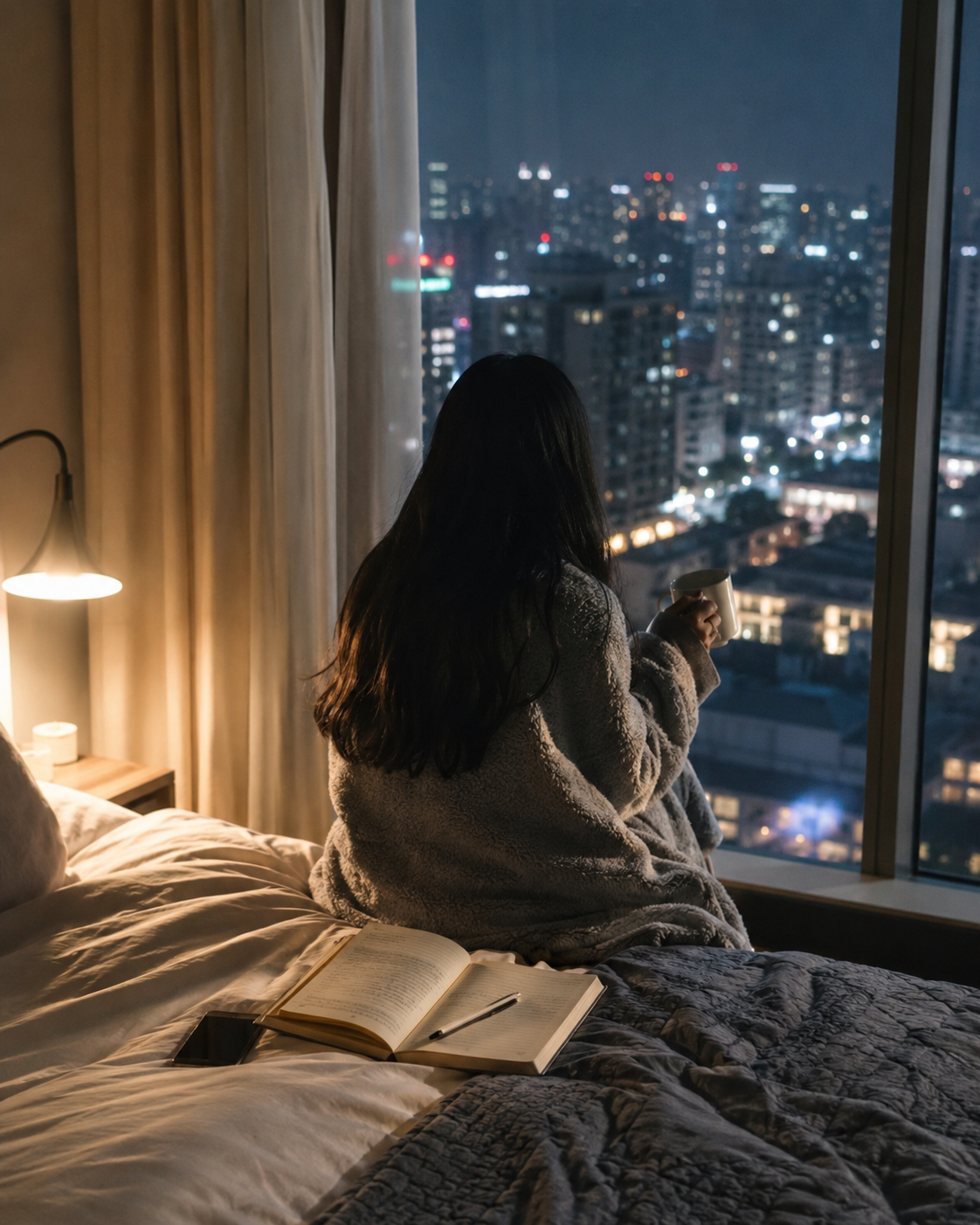
Stress can make it harder to sleep—and a difficult night can make the next day feel more stressful.
Understanding this two-way relationship can help us respond with greater care, rather than blaming
ourselves for not being able to “switch off.”
Estimated reading time: 7 minutes
Tired, but unable to switch off
You have had a long day.
Your body feels exhausted, yet the moment your head reaches the pillow, your mind becomes busy.
You replay a conversation. You remember something unfinished. You begin planning tomorrow.
Then you notice the time, calculate how many hours of sleep remain and become even more worried
about not sleeping.
This experience is common because sleep and stress are closely connected.
Stress can interfere with our ability to settle and sleep. At the same time, inadequate or
poor-quality sleep can affect mood, concentration and emotional regulation, making everyday
pressures feel more difficult the following day.
The result can become a repeating cycle:
Stress makes sleep harder. Poor sleep makes stress feel heavier.
Understanding this cycle is not about giving yourself another problem to solve. It is about
recognising that struggling to sleep during stressful periods is not a personal failure.
Your body may simply be trying to protect you.
What happens in the body when we feel stressed?
Stress is a natural physical and emotional response to challenge, uncertainty or perceived danger.
When the brain identifies a threat, the body activates its stress response. Hormones are released,
the heart and breathing rates may increase, muscles can become tense and attention becomes more alert.
This “fight-or-flight” response is useful when we need to react quickly. But it is not the ideal
state for falling asleep.
The body may not always distinguish clearly between immediate physical danger and modern pressures
such as:
An unfinished deadline
Financial concerns
Family responsibilities
Relationship tension
Health worries
Difficult news
An uncomfortable conversation
Fear of not sleeping well
The threat may not be physically present, but the body can still remain watchful.
That is why telling yourself to “just relax” is rarely enough.
Your thoughts may know that you are safely in bed, while your nervous system is still behaving
as though something needs your attention.
How stress affects sleep
1. Stress keeps the mind alert
Worry encourages the brain to review problems, predict outcomes and search for solutions.
These processes may be useful during the day. At bedtime, however, they can make it difficult
to move from active thinking into rest.
Stress, anxiety and worry are recognised causes and risk factors for insomnia and other sleep
difficulties.
2. Stress can create physical tension
Stress is not experienced only in the mind.
It may appear as a tight jaw, raised shoulders, a faster heartbeat, shallow breathing,
digestive discomfort or a general feeling of restlessness.
Even when you are lying still, your body may not yet feel settled.
3. Stress changes evening behaviour
During difficult periods, we may unintentionally adopt habits that interfere with sleep.
We might:
Work later into the evening
Scroll for longer to distract ourselves
Drink more caffeine to manage daytime fatigue
Use alcohol to try to unwind
Exercise, eat or go to bed at irregular times
Spend more time worrying in bed
These habits are understandable attempts to cope. But they may make it harder for the body
to maintain a reliable rhythm.
4. Worrying about sleep can become another source of stress
After several difficult nights, bedtime itself may begin to feel stressful.
You may watch the clock, calculate the hours remaining or try very hard to force sleep.
Unfortunately, the pressure to sleep can increase alertness and make the process more difficult.
The NHLBI notes that worrying about whether you will sleep enough and repeatedly watching the
clock may increase the risk of insomnia or make it worse.
Sleep is something the body allows—not something we can command.
How poor sleep affects stress
The relationship works in both directions.
A difficult night does not only make us tired. It can change how we experience the following day.
Sleep deficiency may affect attention, decision-making, memory, mood and the ability to think clearly.
It can also interfere with work, social functioning and everyday activities.
After inadequate sleep, you may notice that:
Small problems feel unusually large
You become irritated more easily
Concentrating requires more effort
Decisions feel overwhelming
Emotional reactions become stronger
You have less patience with yourself and others
Healthy choices feel more difficult
Research reviewed by the American Psychological Association found that sleep loss can reduce
positive mood and increase symptoms associated with anxiety. Observational research has also
found an association between inadequate sleep and frequent mental distress, although these
findings do not prove that sleep loss is the only cause.
This helps explain why the same challenge may feel manageable after a restorative night and
overwhelming after several nights of poor sleep.
It is not weakness.
A tired brain simply has fewer resources available.
The sleep–stress cycle
A stressful day
You remain mentally and physically alert.
↓
Difficulty settling at night
You think, plan, scroll or watch the clock.
↓
Short or disrupted sleep
You wake feeling unrefreshed.
↓
Lower emotional capacity
You feel more reactive, distracted or overwhelmed.
↓
The next day feels more stressful
Your nervous system receives even more signals that something is wrong.
↓
Bedtime becomes difficult again
The cycle is real, but it is not permanent.
You do not need to solve every source of stress before sleep can improve. Small changes at
several points in the cycle can begin to reduce its intensity.
Six gentle ways to interrupt the cycle
1. Give worry its own time
Trying not to think about something often makes it feel even louder.
Instead, create a short “worry window” earlier in the evening.
Take five or ten minutes to write:
What is worrying me?
Is there anything I can realistically do tonight?
What is the next small action?
What needs to wait until tomorrow?
Writing down concerns or preparing a short list for the next day may help move repetitive
thoughts out of bedtime. NHS sleep guidance recommends talking about worries or writing them
down rather than carrying them silently into bed.
Finish with a clear closing sentence:
“I do not have to solve this tonight.”
2. Create a transition—not an instant stop
The nervous system may struggle to move directly from work, responsibility or upsetting
information into sleep.
Give yourself a short transition period.
For 20 to 30 minutes before bed:
Lower the lighting
Put away work
Stop checking the news
Reduce unnecessary notifications
Prepare a caffeine-free drink
Read, stretch or listen to something gentle
The goal is not to make yourself sleepy on command. It is to stop sending the brain fresh
signals that it needs to remain alert.
3. Use the body to reassure the mind
Stress often begins to soften when the body receives signals of safety.
Try one simple physical practice:
Take several slow, comfortable breaths
Relax your jaw and lower your shoulders
Stretch gently without turning it into a workout
Place both feet on the floor and notice the support beneath you
Take a warm shower
Hold a warm cup and pay attention to its temperature
Deep breathing, stretching, meditation, journalling and making time to unwind are among the
healthy stress-management practices recommended by the CDC.
Avoid forcing very deep breaths if that feels uncomfortable. A calm practice should help you
feel safer, not become another performance target.
4. Protect your sleep rhythm
Stressful periods can make routines disappear precisely when they are most helpful.
Try to keep your waking time reasonably consistent, even after a difficult night. Maintain
regular meals, seek natural daylight during the day and include movement where appropriate
for your health.
A predictable rhythm gives the body useful information about when to be active and when to
prepare for sleep.
Most adults generally need around seven to nine hours of sleep, although individual needs vary.
5. Reduce the habits that borrow calm from tomorrow
Some choices provide short-term relief while quietly disrupting sleep later.
Be mindful of:
Caffeine later in the day
Alcohol used as a sleep aid
Heavy meals close to bedtime
Long periods of evening scrolling
Working from bed
Sleeping very late after a poor night
Alcohol may initially make a person feel sleepy, but it can contribute to disrupted sleep later.
Caffeine and nicotine can also interfere with sleep for several hours.
The goal is not rigid perfection. It is simply to notice whether today’s coping strategy is
making tomorrow more difficult.
6. Remove the pressure to achieve perfect sleep
One poor night does not mean the entire week is ruined.
Constantly evaluating your sleep can turn rest into another performance measurement.
When sleep does not arrive easily, try replacing:
“I must sleep now.”
with:
“I am allowing my body a quiet opportunity to rest.”
This change does not guarantee sleep, but it can reduce the feeling that bedtime is a test you
are failing.
A five-minute reset for a stressful night
When your mind feels especially busy, try this short sequence:
Minute 1: Name what is happening
Say quietly:
“I am feeling stressed. My body is trying to protect me.”
Minute 2: Release physical tension
Unclench the jaw, lower the shoulders and soften the hands.
Minutes 3–4: Lengthen the exhale gently
Breathe normally and allow the exhale to become slightly slower than the inhale,
without forcing it.
Minute 5: Choose one next action
Write down the thought, read something quiet, prepare a warm caffeine-free drink or return
to bed without checking the time.
The purpose is not to eliminate every thought.
It is to show the body that the thought does not require immediate action.
Sleep is not the only answer to stress
Improving sleep can support emotional resilience, but sleep alone cannot remove an unhealthy
workload, financial pressure, grief, relationship difficulties or an unsafe situation.
Sometimes stress is not a signal to practise more self-care.
Sometimes it is a signal that something in life needs support, a conversation, a boundary or
meaningful change.
Helpful responses may include:
Speaking honestly with someone you trust
Asking for practical help
Reducing commitments where possible
Taking breaks from distressing media
Spending time outdoors
Setting clearer work boundaries
Contacting a qualified health professional
A calming ritual should support you—not teach you to tolerate circumstances that are
continually harming your wellbeing.
When should you seek professional support?
Speak with a doctor or qualified healthcare professional when sleep difficulties:
Continue for several weeks or frequently return
Affect work, driving, mood or daily functioning
Cause severe daytime sleepiness
Occur alongside persistent anxiety, low mood or panic
Include loud snoring, choking or gasping during sleep
Do not improve after changing your sleep habits
Insomnia and sleep problems may have many causes, including stress, anxiety, depression,
medications, pain, hormonal changes, sleep apnoea and other health conditions.
Professional support is not reserved for a crisis.
You deserve help before exhaustion becomes your normal.
A note from Life With Health
Sleep and stress are closely connected because both involve the same human need:
To feel safe enough to let go.
We cannot remove every difficult thought before bedtime. We cannot control every night of sleep.
But we can create small signals of safety.
A softer light.
A closed laptop.
A warm cup held in both hands.
A thought written down instead of carried alone.
A reminder that nothing more is required tonight.
Rest is not a reward for finishing everything. It is part of what helps us meet tomorrow.
Explore the ritual
Create a quieter transition into the evening with thoughtfully chosen tea, natural body care
and simple home rituals designed to help everyday life feel a little less hurried.